In an absolutely shocking turn of events (/s), the whole PSD discovery was yet again the tip of the iceberg, not the core of the onion, so let’s take a stroll through Cooper’s and my last four months, shall we?
Last time I wrote, it was the week before Cooper’s first recheck after his seven weeks with Dr. Green. He seemed a lot better at the time, but I had a niggling feeling that there was something more going on than just the PSD—he’s not built terribly, there’s nothing about him conformationally that should predispose him to that—and so I requested hind feet films when our vet was out in October. I told her that I wanted them for peace of mind, so she took them, and then immediately turned to me and said, “You wanted these to see if he was negative, didn’t you?”
Indeed I did.
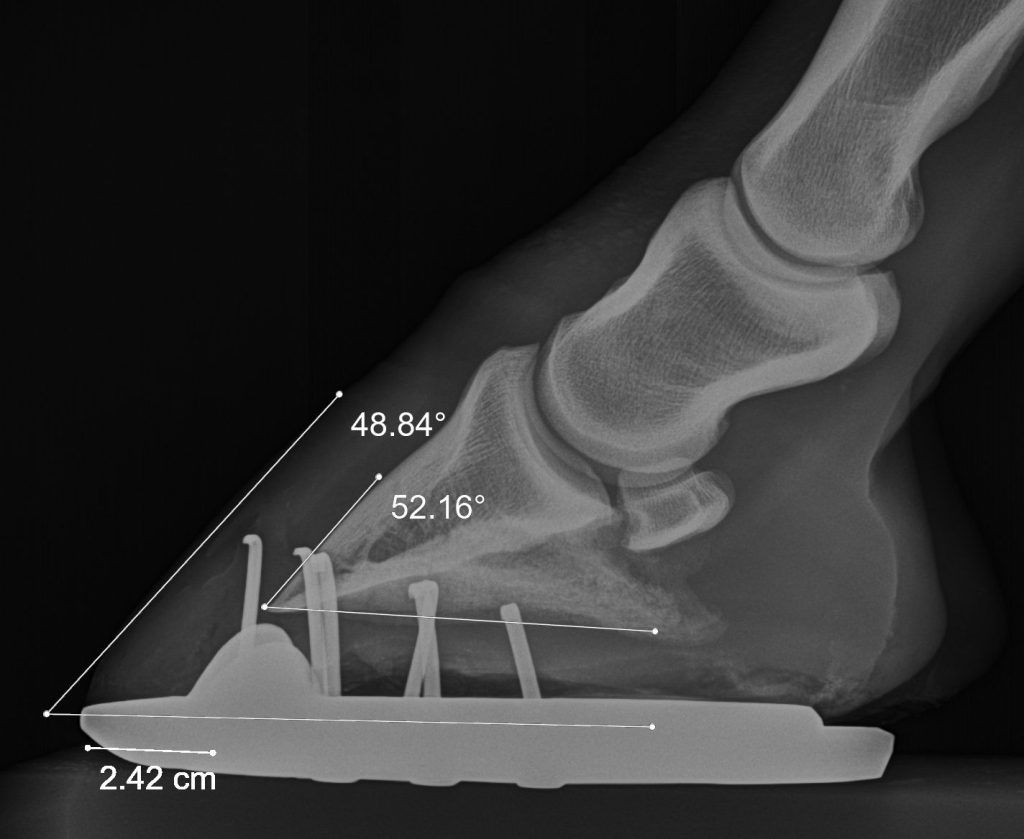
As you can see in the x-ray, he was pretty darn negative in his right hind. His left hind was just barely negative—less than a degree—but either way, this was it. This was the answer we had been searching for. This was the answer for why my horse, who has no glaring conformational flaws to speak of aside from pasterns that are a little too long in the front, who has no kissing spine or neck arthritis or any bony changes anywhere that we’ve looked, has had chronic suspensory issues (which were worse on the right side) and soreness in his SI and back and withers for pretty much the entire time I’ve owned him. I treated the symptoms—he got regular chiro work to keep his back more comfortable, and I did his carrot stretches religiously—but it’s no wonder that we never solved the problem. It’s no wonder that he had such a hard time lifting his back and using himself properly, even though he really did try. He was literally set up for failure from the beginning.
Luckily for me, our farrier was there for one of our barn’s regular Monday visits, so he came over when he had a break between shoes and looked at the x-rays with our vet, and they came up with a game plan on the spot. We weren’t going to take Cooper’s shoes off that day—he was halfway through his cycle and due two weeks later—but the next time his feet were done, he was getting wedge pads with full frog support on both hind feet to lift his heels and get the strain off of his suspensories so that we didn’t reinjure them. In the meantime, I had my own instructions: trot and trot and trot and trot.
Those weren’t the instructions I was expecting during that visit, to be honest. I figured we would be going back to tack walking and maybe throw five minutes of trot in there to start, but our vet had a different plan in mind after she watched him jog in hand both in the arena and in the parking lot: do an internal blister of his stifles and put him back to work. He’s always been lanky, and we’ve had on-and-off stifle issues as he’s grown, but all of my walking and trotting of the many hills of western Pennsylvania to try to strengthen the area just wasn’t cutting it. His stifles were loose and his hind legs weren’t as stable (lol) as we would like them to be, so while that wasn’t causing our canter problems, it definitely wasn’t helping matters. The idea had been tossed around before—our vet says Cooper is the first horse she’s ever seen where she thought during the very first visit that he needed to have this done—but now that he was allowed to come back to work, it seemed like an ideal time, so that was what we did.
She did the internal blister on both legs, and then I got on my (drugged) horse for the first time in just over three months (thanks, reserpine), and we trotted. We trotted and trotted and trotted, and then I got on him again the next day and we did the same, five days in a row. It went better than any of us could have expected. He had a little bit of inflammation the second day, but it didn’t get huge, it didn’t get ugly, he wasn’t grumpy when you touched the area, and I could feel the difference. I could feel how much steadier his steps were in the hind end at the trot. I could feel him push more. He wasn’t losing his hind end through corners. Our vet watched him go day one and day two and was happy with what she saw, so I then got my next set of instructions (to be put into practice after he got his wedges put on): put him back to work and be serious about it.
He had his toes brought back and the wedges added to his hind feet on October 23rd, and we followed our interim instructions to walk only for the first week to let him get used to the feeling. We’d hiked his heels up pretty far and he definitely wasn’t quite sure what to make of it, so rather than shocking his mind and his body and potentially causing different injuries by going too fast, he and I went for some nice quiet wanders around the farm and the surrounding properties.

Week two, we slowly added in some trot work, and he really did not know what to do. He was trying to go around the same way he always had—not through his topline, guarding himself to protect the uncomfortable areas of his body—and the wedges wouldn’t let him do that. The wedges forced him to move in a way that was biomechanically correct, and I really can’t describe him as anything other than confused. He never felt right when we picked up the trot, but he also didn’t feel lame. He just felt like he didn’t know where his feet were supposed to go, so for all intents and purposes, we taught him how to trot again, and every ride, the transition from not quite right to comfortable and pushing came just a little bit faster until he was comfortable from the very beginning.
It sounds terrible, but I had never felt him like this before. I had never felt him properly push from the hind end, sit back into downward transitions rather than collapsing, actually lift his back and use himself because he finally could. He was stretching over his topline and even the moments where he wasn’t through weren’t horrible giraffe inverted experiences. Both of us had absolutely no fitness to speak of, so we started slow—twenty to thirty-minute rides, walking and trotting, no canter—and focused on restarting him yet again, properly. We picked back up a weekly thirty-minute walk/trot lesson to make sure that I (in all of my adult ammy glory) didn’t accidentally make him go around wrong again, and slowly and steadily, we both started to get stronger.
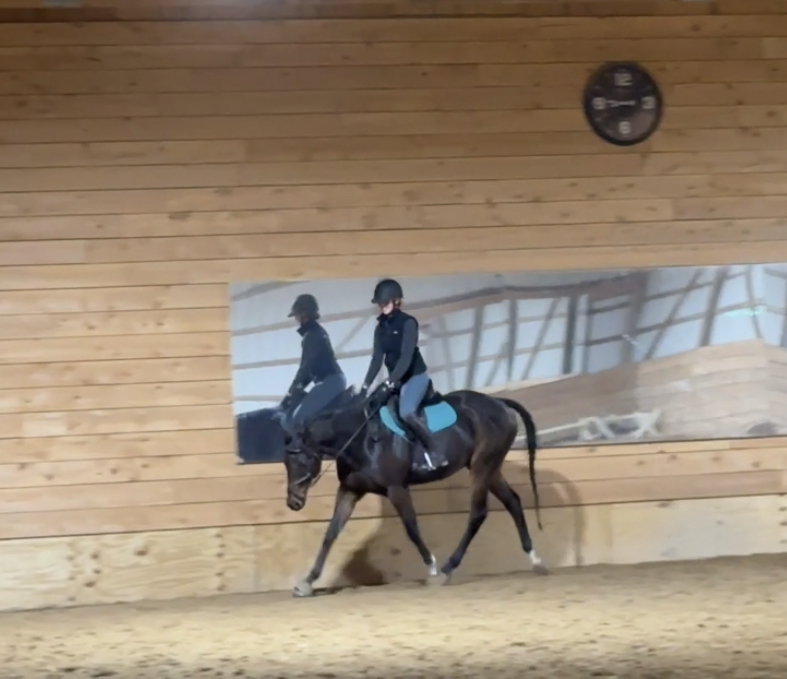
Our vet watched him go under saddle when she came back at the end of November and was pleased with how he was doing, and that was our permission slip to start trying to work the canter back in. Both my trainer and I had seen Cooper gallivanting around his field on the correct lead both ways (with some flying changes thrown in there), so we knew he was feeling better, but doing it under saddle was a bit of a different story. He was definitely stronger, and he could hold it both directions a bit more easily, but he still wanted to swap in the back going into his downward transitions, and he wasn’t convinced that he could soften through his topline at the canter like he did at the trot. I was over there having the internal panic attack that all this money I’d spent had been for nothing, but my trainer had a different response: his muscle memory is all wrong, so put him on the lunge line with a pair of side reins that give him somewhere to go and let him figure it out, and that was what we did.
I know people have ~feelings~ about side reins (I used to be one of them), but in this case, they really were used properly (I made my trainer give me a lesson on using them before I allowed myself to do it unsupervised). They weren’t tight, he had range of motion, he just couldn’t fling his head all the way in the air to totally invert and they gave him something consistent to settle into and find his own contact as he softened down and lifted his back. We’ve only done it four or five times from December to now, but it really has made a difference. He’s started to figure out that he actually doesn’t like to be on different leads in front and back, to the point where he trots and fixes himself most of the time before I can even ask him to. He isn’t totally available to me on the left lead under saddle yet, but in our last lunge session he really stretched over his topline and softened tracking left which is not something that he ever wanted to do before, and he can hold the proper lead now for a long time.
We were supposed to go make our dressage debut (doing Intro B, Intro C, and Training Level 1, lol) at the beginning of January, but the Nor’easter had other ideas so instead I forced Cooper through a very snowy trail ride:

We (meaning my trainer and I) then made the incredibly brilliant decision at the end of January to haul over to Ohio for a gymnastics lesson with a friend of hers. We went into this knowing that Cooper hadn’t jumped properly (or been off-property) in over six months (we’d popped him over a couple of cavalettis the previous week, but that was about it) and that she was bringing her four-year-old who had only been off the track for four months and had been back under saddle for maybe two. With that in mind, we signed up for Intro, but somehow ended up doing what my trainer called Novice questions at Beginner Novice heights. To Cooper’s credit, once we got going and he got over the initial excitement of being out and getting to jump things again, he was very good. It was the first time anyone other than my trainer had coached me while I was on him, and he got the seal of approval from her friend, so I was quite pleased.
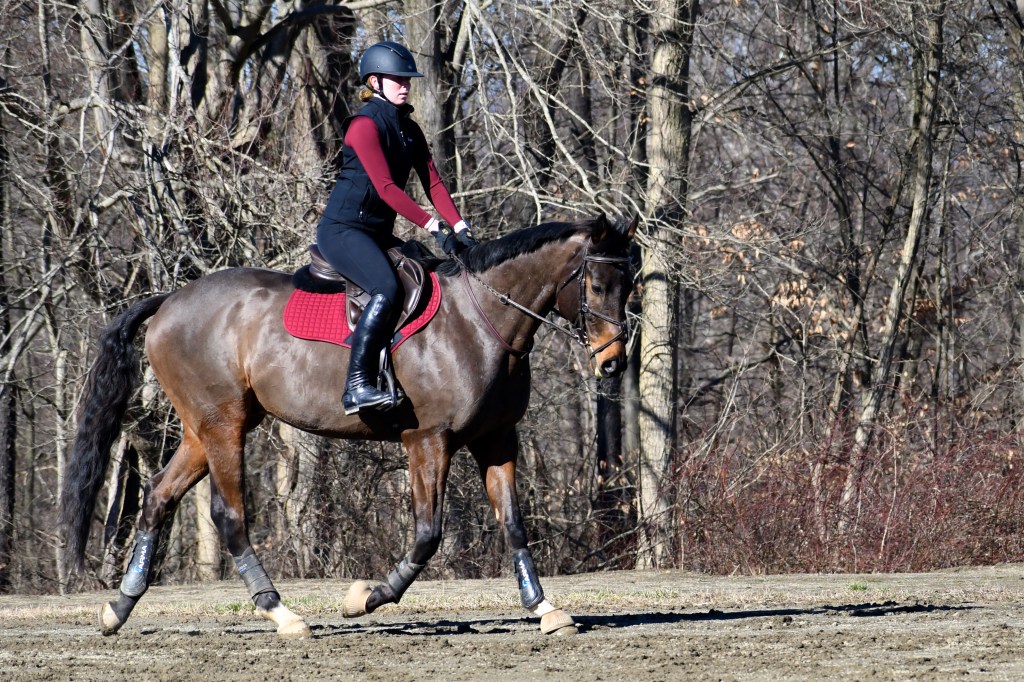
By this point, the new jumps that my trainer ordered back in the fall had arrived, and that combined with unseasonably warm temperatures and a whole bunch of sun equaled jump lessons in the outdoor for everyone last weekend. I wasn’t really sure what to expect, but it was a rare Saturday lesson and a beautiful day, so I asked my best friend to come take some pictures for me, and they turned out wonderfully:
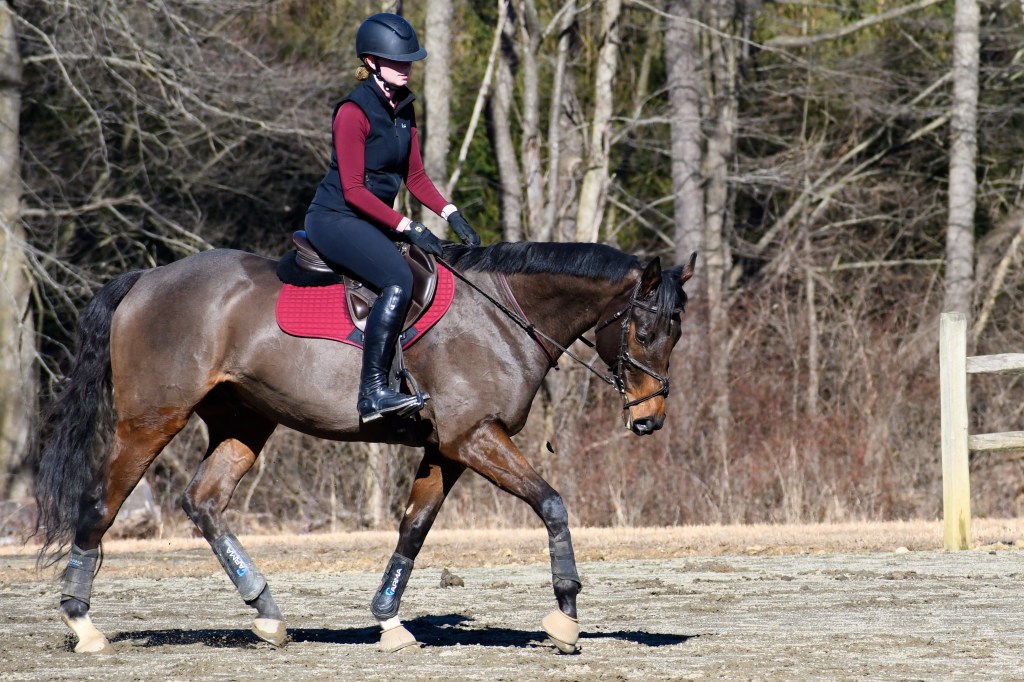
Cooper was a bit… spicy, to say the least—it was our third ride in the outdoor since October and his first time jumping down there since June, let alone jumping down there over brand new fences—but he improved a ton by the end. I am (unsurprisingly) very out of practice with jumping, and a lot of our lesson was really less about the jumping and more about how much baggage both Cooper and I need to let go of. He needs to let go of the idea that it’s going to hurt—his legs are fixed, his feet are fixed, his back isn’t going to have shooting pain in it on the back side of a fence—and I need to stop anticipating a reaction to pain on his part when we land.
I hate that I’m even typing that—I hate that I was asking him to do things that he wasn’t comfortable doing before—but I’m sharing it because it’s real. Every time we land after a fence in the first half of a jump school, he explodes a little bit. It’s not the head down, throwing his hind end in the air, bucking that has twice caused me to be lawn-darted, but he hops because he’s expecting something that doesn’t happen. I’m not soft enough with him coming into fences because I’m still waiting for him to take off and buck on landing, and that just makes him want to pull more (it really is that old adage: How do you get a Thoroughbred to stop? You let go). The more we jump, the less both things happen. He stops hopping on landing because he figures out that it doesn’t hurt, actually, and I’m able to let go and give him that softness that he needs coming into fences.
He’s so, so fun to jump when he’s not anticipating discomfort. He never looks at anything in a way that prevents us from going over it—he might stare down at it between his legs as we’re jumping, but he’s not going to run out or slam on the brakes unless the distance is so bad courtesy of my nonsense that he can’t make it work—and he is so, so springy when I’m not getting in his way. I jump-schooled a pony after my lesson last weekend and the only reason I could stay with his (very round) jump is because of how round Cooper’s is when he actually has a distance that allows him to use himself properly over the fence. At some point over the next month we’re going to set up a jump chute in the indoor and I’m finally going to get to test (on purpose) just how much scope he actually has.
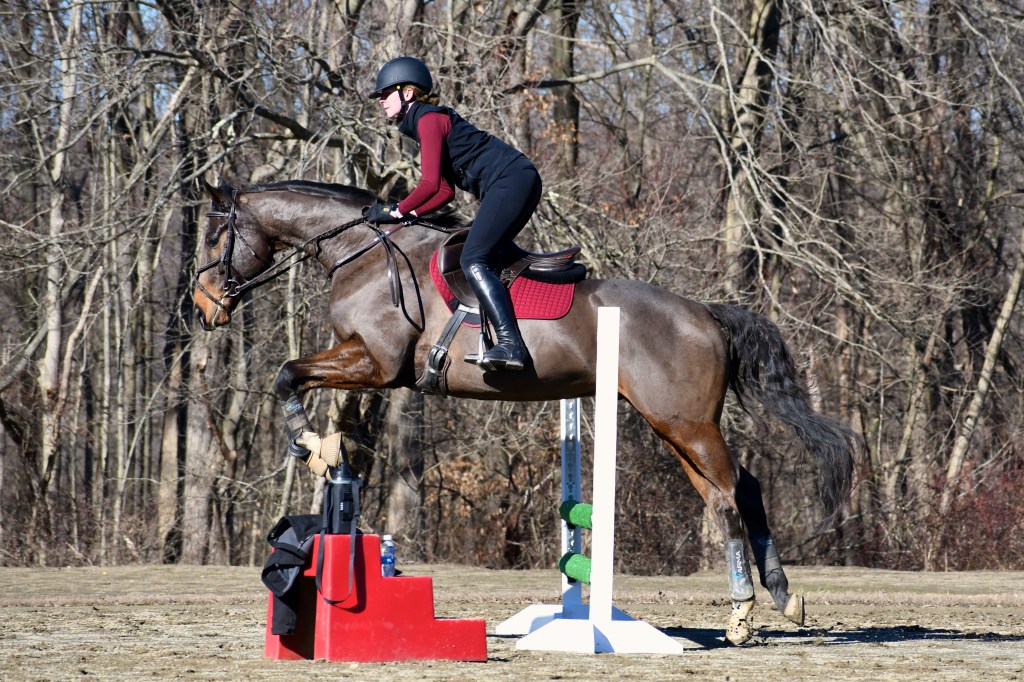
I took a half-day from work on Thursday this past week so that we could jump school again since the weather was still great, and once again, we started off with a lot of anticipation of things being uncomfortable, but I had a completely different horse by the end of the hour and I was riding differently too (who knew you can bring your shoulders back and sit up without getting tight through your arms and hanging). As I said to my trainer, I know some people would respond to his reactions by bitting up to get stronger brakes on the backside, but we both know that isn’t the answer with him (and we both think he’ll be super soft once we work through his baggage). I definitely like the beval for him when we jump because he does need that little bit of help on the check-in if he gets too excited, but he really doesn’t need more than that right now. What he needs is quiet, consistent riding and to jump a lot of (reasonably-sized) fences over the next few months so that he can unlearn the bad things.
(He also absolutely cracked me up over one of the verticals the first time we went over it because he put his head so far between his legs to look at it that I could literally see his front knee and hoof on the left side. I wish I had it on video because we couldn’t stop laughing afterward.)
Today we had his dressage saddle checked, and my feeling that his topline is really coming back fast was confirmed. Our fitter told me that if he gets any wider through his back, we’re going to have to move him up to the next width of gullet plate because of how much he’s filling out. When I told her he’s only been truly back in proper work for two months, she said he must be feeling good because he looks great. He’s shiny, he’s got good weight, he’s muscling up in all the right places and moving well, and his back and hindquarters are finally, finally, finally filling out with muscle in the way that we’ve wanted them to, and I’m really not even fighting for it. I’m not doing anything. I’m just riding him, and he’s going properly, and all the rest of it is coming along as a result.
I spend 90% of my time in my dressage saddle at the moment, so we’re leaving the jump saddle check for a few months from now. My trainer and I both agreed that that was the best move since his back is probably going to change even more between now and the end of April or early May, so we’ll have the fitter back out then to make sure his jump saddle is good and to adjust his dressage saddle again as needed. The jump saddle fits well enough for the bit of jumping that we’re going to do over that span of time, so it wasn’t a huge priority today (it really didn’t get that much use after it was fitted last year, whereas I’ve been in my dressage saddle a ton, so the wool definitely hasn’t shaped itself to his old back in the same way that the dressage saddle panels had and he hasn’t changed gullet sizes yet).
I know that the timeline on all of this probably seems a little rushed for a suspensory injury, since he was really only off for three months and we were back jumping essentially six months after his diagnosis, but here are the things that you have to consider: it was not a full tear on the right and was only compensatory strain with no tearing on the left, the ligaments were not enlarged at all so we didn’t have to wait for any inflammation to go down, and it had already started healing when we did the ultrasound back in July. He’s never been this sound in the almost five years that I’ve owned him, and he’s seen by our vet every six weeks so we’ll be able to catch anything that might be brewing in the future fairly quickly.
There’s still a good bit left for us to do at this point. In a few vet visits, we’ll take new farrier films of his hind feet to see how they’re doing (and see if he’s improved enough that we can drop him down to a lower wedge). I’ve made the executive decision that I’m going to treat him for ulcers because he’s been pretty grumpy about having his girth done up and has been way spookier than usual over the last couple of months, and it would hardly be surprising if he did develop them after all the medications and stall rest and stress of the last six months, so we’ll most likely be starting that in a couple of weeks once I get the omeprazole. We’re still working on fixing the canter under saddle and that’s going to be a continual process of strengthening him and continuing to retrain his muscle memory (although he was way better today—I swapped him over to a double-jointed baucher rather than the loose-ring nathe, and he was way more responsive and less stuck with the baucher action even on the left lead).
It’s all been worth it, though. I’ve spent more money than I want to discuss on this horse in the last eighteen months (I haven’t added it up because I truly don’t want to know), so I can’t really call him my $1500 bargain anymore, but at the same time (as I’ve said to my trainer), even when you add up all the vet bills and tack that on to his purchase price, I’ve still got a really fucking nice horse for less money than a lot of people spend. Everyone loves him. He looks great. He’s moving excellently. He can jump the moon. Even when he’s grumpy with suspected ulcers he still has a puppy-dog personality. He learns everything damn quick and he never stops trying. I’ll never stop kicking myself for not figuring this out earlier, because he didn’t deserve to be so uncomfortable for as long as he was, but there’s nothing like a first horse to teach you all the things that you didn’t know before, and he’s doing brilliantly now.
If I could pass one piece of advice on to everyone as a result of this whole adventure, it would be this: start with the feet. I probably still would’ve had to spend almost all the money that I’ve spent even if I’d x-rayed his feet a year ago, because we needed to quiet his body down to let him get comfortable again, but I could’ve paid a couple hundred dollars a hell of a lot sooner to have the answer to pretty much every question that I’ve had about him over the last (almost) five years. I just didn’t know to ask until my dear friend eventingenzo clued me in to NPA and what it can cause over the last year or so. Worst case scenario, you take the films and you’re out a couple/few hundred bucks to find out that there’s nothing wrong, but you might also take them, find out your horse is negative, and avoid potentially thousands of dollars of diagnostics and treatments trying to repeatedly treat things that are actually symptoms, not the cause. Cooper will be getting (at least) annual films from now on, and so will any other horse I have.
I’m going to leave it here for now because I’m sleepy and I signed us up for a gymnastics lesson tomorrow (sorry, Coop), but have no doubts that I’ll be back. We’re already planning a lot of adventures for this year, so I’m inevitably going to have a lot to report on.
 Spymaster Equestrian